
Off-road driving is a spectrum rather than a single discipline. One extreme is slow, difficult rock crawling, where accuracy is crucial. However, in open desert running, momentum and speed are paramount. To truly maximize off-road performance, your throttle setup must be tailored to the environment. From sensitivity adjustments to torque delivery and traction management, every detail affects how effectively your vehicle handles the terrain. Let's explore how your throttle setup should differ!
What Is Rock Crawling in Off-Road Driving
Rock crawling is a super technical way to hit the trails, where you drive your ride over big stuff like boulders, ledges, and all sorts of rocky ground. Speeds are super slow, usually below 5 mph, and getting it right relies on being precise, having good control, and placing those tires just right. Drivers really count on low-range gearing, lots of torque at low RPM, and a smooth throttle response. Sudden acceleration can lead to wheel spin, loss of traction, or even damage to your vehicle. In this setting, being smooth is way more important than being fast.

What Is Desert Running and Why It’s Different
Desert running focuses on speed, endurance, and momentum. It typically happens on sand dunes, dry lake beds, and in open desert areas. Vehicles often zoom around on bumpy ground, hitting dips, jumps, and loose sand along the way. Desert running is all about quick throttle response, having solid power in the mid to high RPM range, and keeping that momentum going, unlike rock crawling. Delaying the acceleration can lead to getting stuck in soft sand or losing control at high speeds.

Torque Delivery in Rock Crawling vs Desert Racing
The way torque is delivered varies significantly between rock crawling and desert racing, as each terrain has its own needs. When it comes to rock crawling, it’s all about having solid, steady torque at low RPM. This lets the vehicle tackle obstacles slowly and accurately without needing to slam on the gas. This low-end torque helps keep things steady and reduces wheel spin when you're on bumpy ground. Conversely, desert racing requires a broad, adaptable torque curve, with power readily available across low, mid, and high RPMs.
Traction Control Settings for Rocks vs Sand
Traction control needs to be adjusted according to the terrain to enhance grip and performance. In rocky conditions, traction control is generally more restrictive, actively limiting wheel spin to ensure maximum tire contact and prevent slipping on rugged, uneven surfaces. This ensures the vehicle remains stable and minimizes the chance of losing control when navigating obstacles, whether climbing or descending. On sand, traction control is frequently reduced or partially disabled, as some wheel spin is essential for maintaining movement across loose terrain. Rocks demand the highest level of grip and control, whereas driving on sand is enhanced by managed slip and continuous movement.
Why Throttle Setup Is Critical for Off-Road Performance
Throttle setup determines how your vehicle translates pedal input into engine output. This includes both the throttle's sensitivity and the way power is delivered across the RPM range. A poorly optimized throttle setup can lead to:
-
Inconsistent power delivery
-
Reduced traction in critical situations
-
Driver fatigue due to unpredictable behavior
-
Increased wear on mechanical components
In off-road environments, where traction is often limited and conditions are unpredictable, mechanical component issues can quickly escalate into serious problems. By contrast, a properly tuned throttle setup enhances the following:
-
Immediate engine response
-
Rapid acceleration when needed
-
Better control at higher speeds
Simply put, throttle tuning is not just a performance upgrade; it’s a necessity for serious off-roaders.
Best Throttle Setup for Rock Crawling (Low-Speed Control)
The best throttle setup for rock crawling is one that provides maximum control, smoothness, and precision at extremely low speeds. A smooth or low-sensitivity throttle curve is needed, allowing power to increase gradually as you press the pedal. This prevents unexpected surges that could compromise traction or cause the vehicle to lose grip on uneven terrain. The engine must be tuned to deliver significant torque at low RPMs, enabling the vehicle to ascend obstacles smoothly without requiring harsh throttle application.
Low-range gearing (4L) boosts torque and slows the vehicle for better modulation, although traction control is generally restricted to reduce tire spin and maintain grip. If using a throttle controller, use Eco or Comfort mode to moderate pedal reaction. Overall, the car should creep effortlessly with modest, precise driver inputs rather than power.

Best Throttle Setup for Desert Running (High-Speed Performance)
In desert running, the throttle setup must focus on immediate response, robust acceleration, and consistent power at elevated speeds. A high-sensitivity or aggressive throttle curve is preferred, as it ensures the engine responds immediately to pedal input, which is critical for maintaining momentum across sand and unpredictable terrain. The engine must provide a wide torque range, featuring robust mid-range and high-RPM performance, ensuring consistent speed and quick recovery from dips or soft patches.
Traction control is typically reduced or partially disabled to permit controlled wheel spin, helping the vehicle stay on top of loose sand rather than sink in. High-range gearing (4H) enables quicker driving and provides a smoother power delivery. Using a throttle controller, Sport or Race modes are perfect for reducing lag. This environment emphasizes responsiveness and momentum, enabling the driver to react swiftly and maintain efficient movement across open terrain.
Throttle Sensitivity Differences: Slow Control vs Instant Power
Throttle sensitivity refers to how aggressively the engine responds to pedal input. This characteristic must be adjusted based on terrain type. In rock crawling scenarios, a low-sensitivity throttle curve is ideal. This means:
-
Gradual power delivery
-
Minimal engine response to small pedal inputs
-
Greater control at very low speeds
A smoother throttle makes it easier to avoid those sudden jolts, letting the driver glide over bumps with more control. It also helps prevent losing grip, which is super important when you're tackling steep or bumpy surfaces. But when it comes to running in the desert, it's better to go with a high-sensitivity throttle setup. This gives you:
-
Immediate engine response
-
Rapid acceleration when needed
-
Better control at higher speeds
In this environment, hesitation can be costly. A delayed throttle response may cause the vehicle to bog down in sand or lose momentum before a climb. A more aggressive throttle ensures the driver can react instantly to changing conditions.
ECU Tuning vs. Throttle Controllers for Off-Roading
When it comes to upgrading your vehicle's off-road performance, whether rock crawling or desert running, ECU (Engine Control Unit) tuning and throttle response controllers are popular upgrades. ECU tuning offers complete control over engine parameters, custom torque curves and fuel mapping, and optimized throttle response at all RPM levels. It delivers the most comprehensive gains but requires technical expertise and can be more expensive than throttle response controllers.

On the other hand, throttle response controllers provide easy installation, adjustable sensitivity settings, and quick switching between driving modes. These devices are designed to eliminate throttle lag from the accelerator pedal, so they don’t change the ECU's factory settings. It is simpler and more practical than ECU tuning. Let’s look at the best throttle response controller on the market!
How to Improve Your Vehicle's Off-Road Performance with Pedal Commander®?
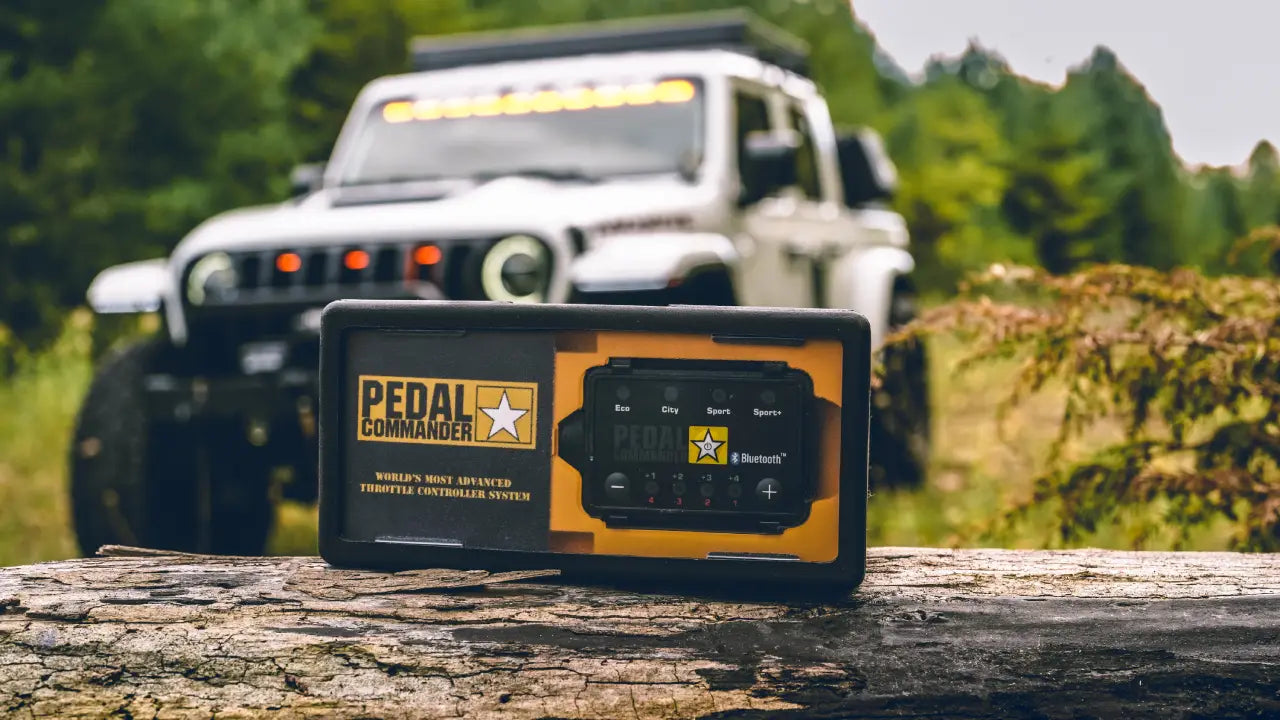
Off-road driving demands precise control, quick response, and the ability to adapt instantly to changing terrain. One of the simplest yet most effective upgrades for improving your vehicle’s off-road capability is installing a Pedal Commander®. This throttle response controller enhances how your car reacts to accelerator input, giving you greater control whether you're crawling over rocks or powering through sand. Let’s look at what Pedal Commander® offers:
-
Customizable Settings: Pedal Commander® allows you to fine-tune your vehicle's throttle response to match your preferred driving style with its four adjustable modes: ECO, CITY, SPORT, and SPORT+. ECO gives you the precise control needed on technical terrains, and other modes improve throttle response for when you need instant power.
-
Instant Throttle Response: Pedal Commander® eliminates throttle lag and delivers instant power, improving the overall driving experience.
-
Effortless Installation: Pedal Commander® is designed to be completely plug-and-play. It installs in under 15 minutes without needing technical expertise or specialized tools.
-
Fuel Efficiency: Pedal Commander® Eco mode reduces throttle sensitivity for better fuel economy during long road trips or stop-and-go traffic, making it perfect for daily driving or long, relaxed highway drives. Keep in mind that fuel economy highly depends on driving habits.
-
Anti-Theft Feature: When activated, Pedal Commander®’s anti-theft feature disables the vehicle’s gas pedal, ensuring no one can drive it or, worse, steal it! Enjoy this feature for the first 14 days FOR FREE, then easily subscribe through the Pedal Commander® mobile app and choose from two subscription plans: $0.99 per month or $9.99 per year—cheaper than a gas station snack!